By Beverley Kilby
Whilst browsing the British Newspaper Archive I came across the following article from the Nottinghamshire Guardian of Friday 13th August 1875:
“A thunderstorm, unprecedented since the year 1830, passed over the Erewash Valley on Saturday evening, accompanied with a very heavy fall of rain. Although much was feared from the floods, it appears that few precautions were taken by those holding lands in the vicinity, and considerable losses were the result. Early on Sunday morning numbers of people were moving along the whole valley, rescuing what they could of sheep, pigs, cattle and horses. Notwithstanding this, however, sheep and pigs, and a horse belonging to an Ilkeston tradesman named Udall, were carried away with the flood. A number of houses lying low near the Potteries at Ilkeston, were rendered uninhabitable, and the residence of Mr Richard Evans was several feet deep in water on the ground floor. The gardens of this gentleman were entirely covered with water. In the meadows the flood rose above the fences, and several stacks of hay were carried away by the current. A nuptial pair, proceeding from Ilkeston to an outlying village, proved the truth of Byron’s words “Love finds its way, even where wolves would fear to stray”, and were determined to reach the altar in spite of the opposing elements. When the horse had proceeded about midway through the water, however, it “shied” into the middle of a field, where the greatest danger was apprehended; and it was with difficulty that the orange blossoms of the bride were kept above water. Another attempt to reach the hymeneal shrine was not made.
At Cossall the torrent carried away a five-foot wall on the farm of Messrs Fritchley, and the house of Joseph Wheatley was several feet deep in water, his valuable furniture being much damaged. The traffic on the Midland line near Ilkeston station was almost at a stand, owing to the very dangerous state of the rails, from beneath which the earth had been carried into adjacent fields. Several thousands of bricks lying in the drying sheds of a brickyard, near Gallows Inn, were under water all day, and were again converted into shapeless clay. The furnaces of the Erewash Valley Iron Co, situated near Trowell, were brought to a stand. The water rose as high as the fire under the boilers, which were extinguished, and the blast engines were standing until Monday morning, when, owing to the speedy abatement of the flood they were again brought into action. The damage must have been very extensive, if the engines had stood a much longer time. Thousands of people visited the different scenes of devastation during Sunday, but the floods had almost disappeared on Monday.”
Intrigued by the opening sentence I had a look for any reports of the 1830 storm/flooding; I found a brief report of the storm of 1830 in the Yorkshire Gazette of Saturday 10th July 1830:
“Nor was it confined to this town (Nottingham); the storm has spread over a vast extent of country, but perhaps has been most felt about Sandiacre, where hail stones of an unusual size did great damage, not only cutting up the herbage, and destroying the fruit and vegetables in the gardens, but also breaking the windows. One hail stone was measured the next morning , after lying five or six hours in a warm night; its girth was more than three inches. At Ilkeston also the storm was very severe; windows were broken, and it was with the utmost difficulty that the coach to Nottingham was piloted through the sea of waters which ran between that place and Trowell.”
Out of curiosity I checked the Nottingham Date Book but there’s no mention of a flood or thunderstorm in 1830. With reporters believing that the August 1875 thunderstorm was the worst since 1830, and having the benefit of the internet and digital searching I thought that I would check for other storms that had caused flooding in the Ilkeston area. Here’s a few I have found:
Derbyshire Advertiser and Journal Friday 20th August 1858:
“At Ilkeston two houses were struck, and much damage was done to the roofs, and one woman was struck blind, but we are happy to say that she was on Monday able to see a little from one eye. An engine chimney belonging to West Hallam colliery was also struck by the electric fluid: a portion of its top was knocked off and a large piece taken out of the side.”
Ripley Advertiser 30 June 1866:
“On Thursday night, the 21st inst., about 12 o’clock, a very heavy rain storm passed over the town of Ilkeston. On looking down the valley on Friday morning it was discovered that nearly all the land bordering on the river Erewash was under water, and the river itself had risen to a surprising height. Most of the houses on and near its banks were much flooded, and one in particular, occupied by Henry Wallis, being situated on a small eminence, about ten yards from the river, was so completely surrounded that the inhabitants were compelled to place planks to pass in and out of the house.”
Derby Mercury 18th June 1879:
“Owing to the late heavy rains there has been an unusually large influx of water into Sowbrook Colliery, belonging to Mr Whitehouse, at Kirk Hallam, near Ilkeston. On Friday the water was several feet deep at the bottom of the shaft, and ordinary operations were consequently suspended . Pumping is now being carried on, and the water is considerably lower. There are large floods in the fields by the side of the Erewash, near Ilkeston, and farmers and other landholders occupying land near the river have many of them been compelled to remove their livestock from the flooded fields.”
Erewash Valley Ilkeston – The Derby Mercury, November 16th, 1880:
“In the neighbourhood of Ilkeston, Sunday was a day of incessant rain, and the downfall, which was very heavy at times, continued until an early hour on Monday morning. On Monday afternoon the Erewash Valley all along the line of the river from Aldercar to Langley Mill and Ilkeston was flooded, many acres being under water on each side of the river for miles. At Langley Mill the lower rooms of the Old Navigation Inn and other business premises and houses near the river were again flooded, and a number of gardens were under water, the damage being done considerable. At Shipley Gate, near Ilkeston, the premises of Mr Bentley, miller and farmer, were flooded, and also the lower rooms of a number of cottages. The roads near[by] were also flooded and impassable. The floods are very large near Ilkeston Potteries and the Midland Railway Station on the Erewash Valley Railway, Ilkeston. Many pit roads near Ilkeston are flooded and quite impassable , and in some cases the carriage roads are also under water. Farmers and other holders of land near the river have been compelled to remove their livestock from the low-lying lands”.
Derby Daily Telegraph 14 August 1886:
Two men struck by lightning at Ilkeston.
“On Friday afternoon a thunderstorm of unusual violence passed over Ilkeston, flooding the town with a great downpour of rain. A sewer in Nottingham Road burst, and some adjacent houses were flooded to considerable depth, causing great inconvenience to the occupiers, who had to remove their furniture to the upper storeys of the houses. A more serious accident occurred at the Manners Colliery, where two men were struck by the electric fluid whilst at work at the colliery screen. One of them named Blant, living in Belper St, was sent home, his injuries being about the shoulder and feet. The other man, Elijah Burrows, aged 40, of Lower Granby St, was seriously injured about the chest, and was at once taken to the Ilkeston Cottage Hospital, where he lies in great pain.”
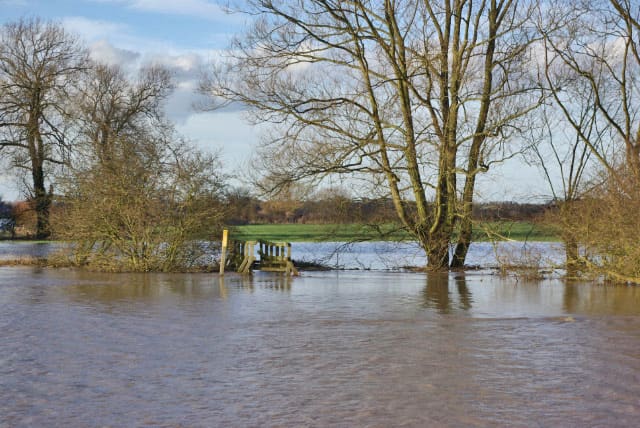
And on Monday 23 May 1932 the Derby Daily Telegraph reported on extensive flooding in Derby and at Ilkeston “Amazing floods, such as have not been seen for more than 50 years, were witnessed yesterday in Ilkeston, when the River Erewash overflowed its banks. The district of Ilkeston Junction, through which the Erewash flows at the foot of Station Road, was transformed into a great lake.” Unfortunately a young girl was swept away in the floods. “Although rain fell all Saturday, serious flooding did not start until about 10am yesterday, when the river rose very quickly. The basements of about 100 houses at the foot of Station-road, and surrounding the LMS station, Ilkeston Junction were soon under two to three feet of water… The water retreated about two inches early in the evening, but heavy rain fell again, and few of the flooded-out families cared to risk remaining downstairs, even when the floors were only slightly covered. In many cases [as] the water interfered with the gas supply and flooded-out kitchen fires cooking was difficult. The LMS main line was covered to the tops of the rails. Sleepers and other wooden articles at the side of the line at the station floated about over the rails , and men were sent out to keep the line clear. Standing last night on the Erewash bridge on Station road a startling scene presented itself. On the north side a great river, about a hundred yards wide, swept in a terrific current from the LMS branch line bridge and taking a majestic curve rushed under the little Station road bridge.
The total damage is hard to estimate. Allotments were ruined, cats, pigeons and rabbits drowned, and many household articles ruined or badly damaged. The district is a working-class one, on whom expense falls heavily. Police-constable Mallinder and his wife, who live in Lower Station Road had to find other lodgings, the ground floor being flooded. Ilkeston Co-Operative branch shop at the same spot was flooded. So too was the Post Office close by. Cellars in the factory of Messrs. Lewis Ltd in Middleton St were extensively flooded.
Between Saturday and yesterday nearly three inches of rain fell in Ilkeston district. Most of the town is on a hill and escaped the floods. Fields round Manners Colliery were transformed into a lake, and several houses at Hallam Fields, which lie low, were submerged. Stanton Ironworks ambulance station was flooded to a considerable depth when the water swept through a masonry barrier opposite. All traffic on the main road to Nottingham was held up some time owing to flooding of the road at Gallows Inn, another low-lying part.”