Extracted from the Ilkeston Advertiser 27th July 1962
By Grant Shaw
A highlight of Ilkeston life in 1909.
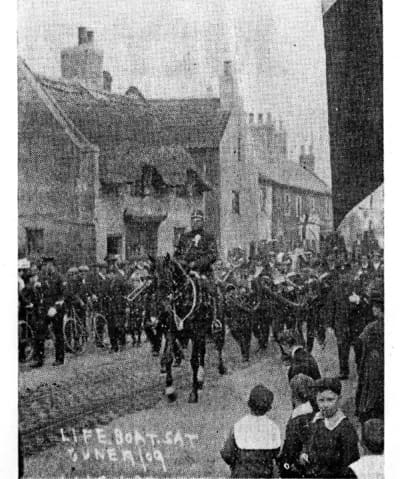
Mr David Martin of 29 Green Lane Larklands sent us this photograph of Superintendent Daybell on horseback riding at the head of the parade on Ilkeston’s Lifeboat Saturday, June 19th, 1909. A splendid spectacle it must have been too.
The Advertiser of the day commented on “The fickle character of the elements, which threatened to produce disaster to the long-contemplated lifeboat pageant which for some weeks past had been the talk of the town. A steady downpour continued all the morning, and rumours were current that a postponement was being considered. But the weather improved wonderfully after dinner and continued ideally fine until the last item of a lengthy programme had been completed.”
Of the parade itself, the reporter wrote, “the procession formed up in the Market Place at two o’clock and was divided into four sections, each section being headed by a brass band. Superintendent Daybell rode at the head of the procession as Marshall in Chief. He was assisted by mounted messengers who communicated with the various portions of the long cortege.
Then came the Borough and Ambulance band under Bandmaster T. Wardle, followed by the Ilkeston Fire Brigade whose burnished helmets and uniforms glittered in the sun. They were under the command of Captain H.J. Kilford and they had with them the steamer ‘Queen of the Erewash Valley’ [the horse drawn steam powered Fire Engine], looking spick and span. A number of army and Navy veterans came next, and were followed by a Theatre Royal tableau representing a shipwreck.
Boy Scouts, Boys Brigades and scholars from the town’s many Sunday schools formed the second section of the parade. In the other sections various tableaux and a lifeboat crew from Skegness whose bowsman [sic] Joseph Grunnill had helped to save no less than 130 lives in his forty years of service and whose last appearance before retirement was in the parade through the streets of Ilkeston.
The streets of the town through which the procession passed were gay with decorations. The Church Institute was conspicuous for the elaborateness of its adornment, and along with the Town Hall and other buildings, hoisted its flag. All the trams were suitably decorated, displaying miniature union jacks.
A programme of dancing and entertainment at the Rutland recreation ground concluded the day’s events and a Lifeboat service was held in the open air at the Market Place on the Sunday night. Net proceeds from the pageant were about £100.
Among the cash taken in the lifeboat boxes at public houses of the town where 2 trouser buttons, a theatre check, a jubilee medal and a dead beetle, the Advertiser was told. A two shilling piece was the biggest coin collected in the boxes and a half penny was the smallest. Some wag in a public house put a quantity of beer in one of the collecting lifeboats thinking perhaps the counters would be thirsty. “It was the dirtiest looking money ever turned out of a box” the treasurer commented.
It took 15 minutes for the procession to pass a given spot. Perhaps the most exciting part of the parade was the finish. On getting to the top of Bath Street, the Fire Engine, Manual and Escape finished in a gallop to the Town Hall yard.
There were more cameras out in the streets of the town during the afternoon than had ever appeared before. There was to have been a balloon ascent at the recreation ground after the parade, but the balloonist had an accident and fired the balloon. It caused about as much excitement and amusement as if it had gone up.”
All in all, it must have been quite a day.