By Jeff Wynch
William Fletcher came to Ilkeston from his home town of Southwell to set up as a chemist on Bath Street in 1868. Under the Pharmacy Act of that year, the terms Chemist and Druggist could only be legally used by those who had passed a basic Pharmaceutical Society of Great Britain examination. It is therefore not unreasonable to assume that Fletcher was among the first to be registered.
Chemists and druggists could be found on every High Street where they mixed and dispensed chemicals and medicines. They also sold a range of other goods such as tobacco, alcohol, toiletries, cosmetics and food. Much of their trade was with people who could not afford doctors and their prescriptions and had to depend on “patent” or “proprietary” medicines off the shelf or on the chemist’s own concoctions.
By 1877 Fletcher had diversified. Trade directories described him as a chemist, mineral water manufacturer and dealer in wines spirits and ales. His sister’s son James George Redgate of Nottingham went into the mineral water business at about the same time. Records show both trading from 1877, but Fletcher had possibly started making and bottling mineral water earlier at premises described as “store rooms, stables and offices” on the corner of North Street and Chapel Street which were built in 1875
Fletcher’s Mineral Waters seems to have led a nomadic life. As well as the North Street/Chapel Street premises, the following addresses were used for the manufacturing and bottling plant: 103 Awsworth Road (1879); Bath Street (1883); Granby Street (1885); Chapel Street (1887); Granby Street (1889) Chapel Street (1895) Chapel Street (1904).
From 1889 the Chapel Street building also housed Fletcher’s Erewash Brewery Company, which was a separate entity from his chemist and mineral water business. The brewery failed in July 1904 when a Receiver was appointed, and it had closed by the spring of 1905. The building was subsequently used for various industrial purposes but was demolished in the early 1980s to make way for the Ilkeston Inner Relief Road (Chalons Way).
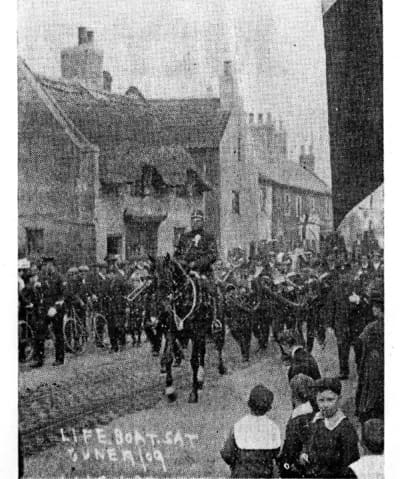
Fletcher sold his beverages both from his shop and through a home delivery service. He employed at least one man to drive a horse and cart taking stout and mineral water to customers. (See end of article). The non-brewing businesses seem to have peaked in 1895 when Fletcher (“of 15 Granby Street and Medicine Hall, Bath Street”) was listed as “wholesale druggist, wine, spirit and ale merchant and mineral water manufacturer and bottler”. In 1904 both mineral water production and brewing were back at Chapel Street, and this is the last time either is recorded. By 1911 Fletcher was described as a chemist and wine and spirit merchant by Trueman and also in Kelly’s 1912 Directory.
Fletcher applied for at least four patents relating to mineral water bottling (one of his other inventions was for a puncture-proof band for bicycle tyres; see Deals on Wheels, 2020, published by the Society) The first, in 1892, was for a machine to apply labels to “bottles, cans, canisters and other receptacles.” The second in September 1894 was for “improvements in and relating to” such machines. And the third in March 1895 was “to provide means whereby the labelling of bottles and the like is carried out with greater rapidity, efficiency and economy than has been hitherto attainable.” This patent was accepted on 21/03/1896.
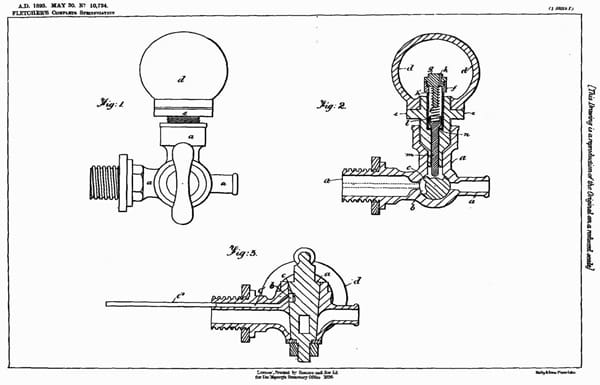
Fletcher’s final, and most interesting, invention was patented on 08/02/1896. It was an “improved means for aerating potable liquors both alcoholic and non-alcoholic, imparting a palatable exhilarating property”. The device was fitted to a container such as a stoneware jar like the one pictured. Referring to Fletcher’s drawings, the cylinder {d} is filled with “carbonic acid or a like suitable gas” under pressure. It is then screwed into the delivery tap which is in turn screwed into the bottle’s tap hole. Here’s how it worked: Turning the tap to deliver the drink moves the small projection {c} into contact with the end of the piston {m} forcing it up. The gas which has already passed through opening {h} into the inner valve box {f} forces itself into valve box {e} and then into the slot {b} and along bore {c1} and tube {c2} into the liquid.
I have no idea how successful any of Fletcher’s inventions were. There is no evidence that he ever actually made them or had them made.
Fletcher’s diversification into mineral water manufacturing and bottling lasted about nineteen years with many changes of location; the brewery survived for fifteen years. That both of these enterprises lasted so long is proof of some level of success, but competition from bigger companies would have made small local concerns like his less and less viable. He eventually reverted to his core profession of Chemist. Fletcher’s nephew however created a drinks company that grew, thrived and kept its sparkle for about a century called Redgate Ltd.