Extracted from the Ilkeston Pioneer newspaper 10th March 1922
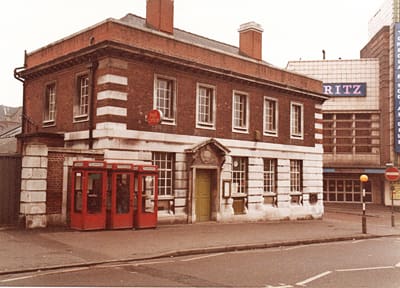
“Time works continuous changes, and the old order of things give place to the new. The modest and unpretentious building in the Market-place, Ilkeston, which has hitherto served to house the ever-growing needs of the postal service, closed its doors on Saturday night at seven o’clock, and when a hour and a half later the last dispatch took place the passing of the old Post Office may be said to have been completed and another page in the annals of the Borough had been written off and relegated to the past.
The new premises lower down the street were quickly and unostentatiously opened at the customary hour on Sunday morning the full postal and telegraphic service was resumed was resumed without interruption. It was indeed a wonderful transformation and wrought with such smoothness and facility and absence of fuss, and without the slightest dislocation that calls forth quiet determination in the minds of those who gave the matter consideration. Many people will remember the change – which at the time seemed as important an advance as the present now is – from the building which formerly served as the Post Office to the one which has just now been superseded by the fine palatial block in South-street adjoining the Free Library.
The Post Office business at that time was carried on in a portion of the same block as the premises now discarded – in a shop occupied by the late Mr. Chas. Potts, chemist and grocer. It was a small and inconvenient building, and on the death of Mr. Potts the premises changed hands, and were remodelled. The opening of the late Post Office was certainly a tremendous advantage in every respect on the old condition of things. A very much greater stride has now been made over that which took place in the removal to the new building, which constitutes an architectural asset to the town, and supplies a want that has been very long felt.
Ilkeston can now boast of a Post Office, so far as the building is concerned, that is worthy of the size and importance of the town. The cost is over £12,000, and the work has been carried out by Mr. A. Earnshaw, East-street, the principal contractor, with Messrs. L. Buxton (joinery), and Greenhough and Johnson (plumbing), sub-contractors, and Mr. [Henry] Rees (from H.M. Office of Works) as architect, and Mr. A.F. Cole as clerk of works. In a short time the Telephone Exchange will be transferred from Wilmot-street and housed in the new premises, accommodation having been provided for the telephonic apparatus, and also for a caretaker to reside on the second floor. The premises are illuminated throughout by electricity and heated by the hot-water system. Red brick and Portland stone have been used in the construction the building. On the first floor is a large and handsome public office 23ft. by 21ft., with mosaic floor and mahogany fittings. In this office facilities are provided for writing telegrams, postcards and letters, and there is a letter box inside the building (as well as on the outside) in which to post the correspondence. A telephone cabinet is also close to hand. The public counter is apportioned into different departments, over which is posted a classification such as “Stamps”, “Telegrams”, “Insurance Stamps”, “Money Orders”, etc., etc., which will make for the Post Office staff. Adjacent is the telegraph messengers – so different from the old order of things.
At the rear of the building is the sorting office, a large and commodious room 34ft. by 28ft. There is also the postmaster’s sanctum, messengers’ room, separate retiring rooms for postmen and clerks and for the lady clerks, apparatus and battery rooms, etc. The retiring rooms are provided with every necessary convenience for cooking meals, and numbered and locked compartments in which to keep their food, etc. On the second floor, as mentioned previously, are the caretaker’s living rooms, lady clerks’ retiring rooms, besides switch room, etc. A staircase leads up on to a flat roof at the back, which will serve many a useful purpose in the summer time.
The building throughout is constructed on the fire-proof principle with concrete floors and floors of maple wood blocks. The outside frontal aspect is pleasing, and the broad pavement enhances the status and appearance of the building, which is one of the finest of its kind in the town, and reflects the highest credit on the contractor, sub-contractors and others concerned in its erection. There is a spacious yard at the back, with stores and sheds and other accommodation.”
This building closed as a Post Office in February 1989 and after spells as a Building Society Office, a restaurant and a pub called ‘The Charter’, is now host to “Hogarth’s” Public House.