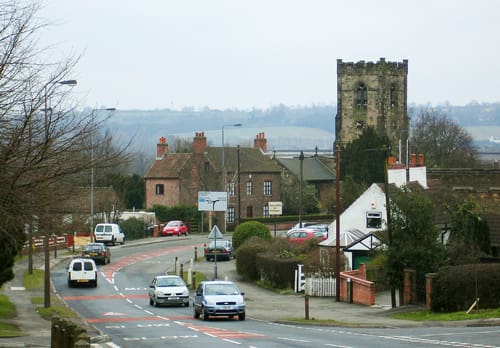
Mapperley has a long history and is mentioned in the Domesday Book.
A Chapel was established here in about 1230 by Hugh de Strelley by arrangement with the Abbot of Dale as patron and Rector and was sanctioned by Alexander Staveney, Bishop of Coventry and Lichfield from 1224 to 1240. This ‘chapel of ease’ was an important stopping point on the lead mining route between Wirksworth and Crich to Dale Abbey and Sandiacre.
In 1266 a weekly market was granted by charter to Simon de Aderne, Lord of the Manor, along with the right to hold a fair at the Festival of the Holy Trinity.
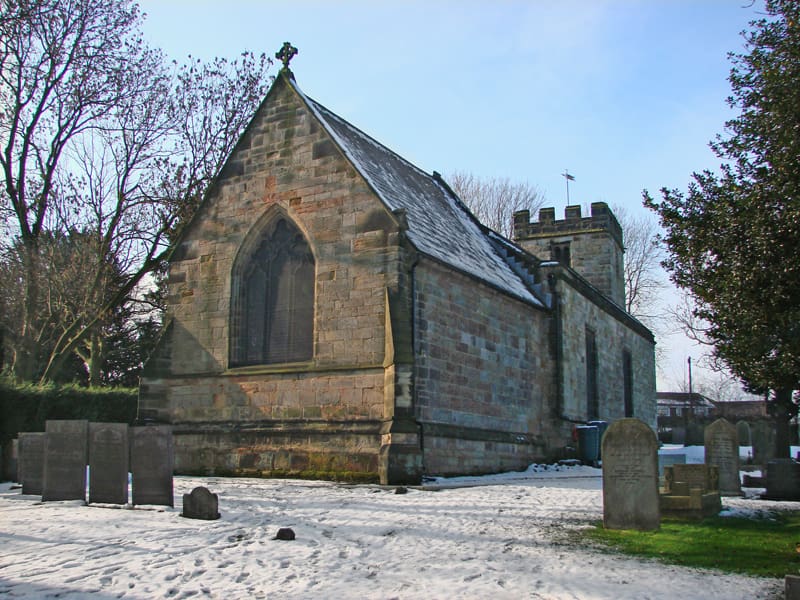
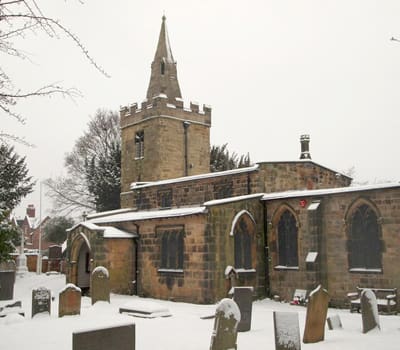
Mapperley became part of the parish of Kirk Hallam. In 1650 a Parliamentary Commission reported “Mapperley is a member (of Kirk Hallam Parish) and lies remote and may be united to West Hallam”, but nothing was done about this suggestion. In 1851 a church was built on this site with stone given by Mr Drury Lowe and money contributed by Mr Alfred Miller Mundy of Shipley Hall. The architect was Thomas D. Barry of Liverpool, and the builder was T. Brown of West Hallam. The total cost of the work was £727 10 shillings and three- and three-quarter pence plus architects fees. It was a plain building in what was termed as the ‘Early English’ style, consisting of chancel, nave, porch and turret containing five bells.
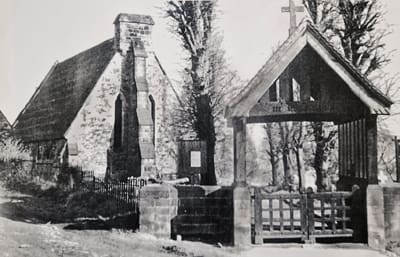
On July 22nd, 1870, Mapperley became a separate ecclesiastical parish. A Wesleyan Methodist Chapel was built in 1874 to accommodate 150 worshippers.
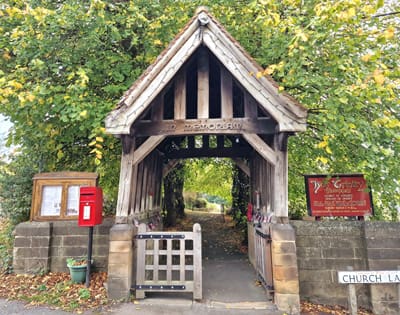
In 1922 the lych gate was built, dedicated as the Parish’s War Memorial and containing the names of those from Mapperley who died in the Great War. Additions were made after the Second World War.
From 1951 the Anglican Parish of Mapperley was held in plurality with the parish of West Hallam. It is now part of a group of parishes including Stanley, Stanley Common, West Hallam and Kirk Hallam.
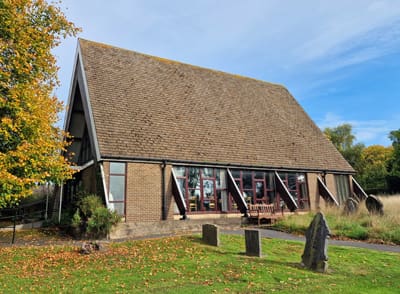
Mining subsidence began to affect the church in 1957 and by 1959 it became unfit for worship. A temporary church building was provided by the National Coal Board. When subsidence ceased, a new church was planned and built, after long negotiations and delays. It opened for worship in April 1966.
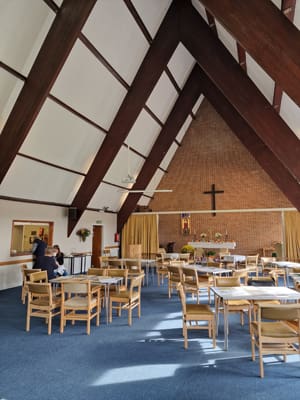
The architects for the new church, Naylor Sale and Widdows of Derby supplied the following notes about the new building:
“The most important basic problem to be solved was that of providing a building of sufficient size and a suitable quality at a very low cost. Another problem was that of designing a structure suitable for a site from under which coal had recently been extracted. A reinforced concrete raft was laid and on it was built a light structure capable of a certain amount of flexing without causing serious damage. The elimination of most of the usual high walls saved cost as well as weight. It is felt that loftiness is very desirable in a place of worship in that, for some indefinite reason the right atmosphere is created. The steep pitched laminated timber trusses provide the height as well as the flexibility which is desired. The plan is simple. There is no chancel or choir between the worshippers and the sanctuary so that those who come here to worship are part of and not separated from the sacrament enacted at the altar. The ancillary buildings contain a choir vestry large enough for parish meetings, priests vestry and toilet accommodation. A “dim religious light” has been avoided and as much as light as possible enters from outside. The low windows with a view of the countryside are intended to emphasise the association between God’s creation and man’s worship. All this large glass area is in double glazing to eliminate undue heat losses. The wall mounted cross is black. The parish has been almost entirely dependent on coal, and this black cross reminds us of this natural bounty”.
Holy Trinity’s design presented several problems going forward, not least the cost of heating such a lofty space in the cold weather. Underfloor heating was installed with a grant, and more funds are being sought for replacement of the old double glazing with something more modern and economical.